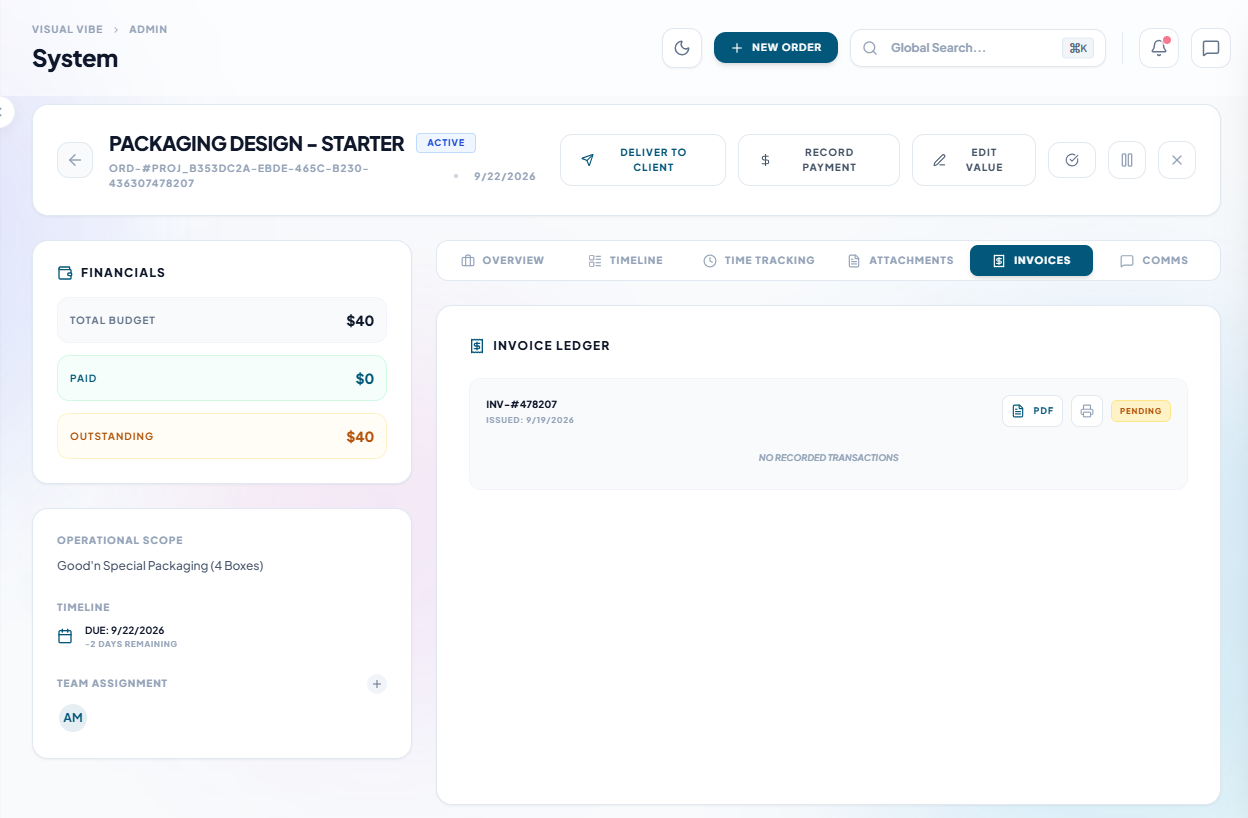
Invoicing software for agencies must connect commercial terms with project delivery. A generic invoice generator can create a PDF, but agency owners also need to know which project produced the charge, whether the client approved the milestone, what has been collected and what direct costs remain.
The right system reduces missed invoices and gives clients a clear financial history without exposing internal salaries, margins or talent payouts.
Start with the agency billing model
List the ways your agency charges: deposits, milestone invoices, retainers, fixed packages, hourly work, recurring services or reimbursable expenses. Confirm whether invoices may use different currencies and how taxes or discounts are represented.
Software should support the model you sell today without making staff rewrite the same project details into a separate finance record.
Connect every invoice to a client and project
The invoice should inherit the correct client, project, currency and commercial context. Users should be able to move from an invoice to the relevant order, milestone or approval.
This connection helps answer whether delivered work has been billed and whether a balance belongs to an active, completed or disputed project.
Separate invoices from payment records
An invoice is a request for payment. A payment record documents money received. Keep them separate so partial payments, multiple transactions and verification remain clear.
Record payment date, amount, currency, method, reference and proof when appropriate. If the platform tracks payments but does not process them, the client interface should say so clearly.
Give clients useful visibility
A client portal should show issued invoices, due dates, paid amounts and balances in plain language. Clients should be able to download documents and understand the next action on mobile.
Protect internal information with role-based access. A client can see the agreed project value and their payment history without seeing labor cost, talent payouts or company margin.
Track outstanding and overdue balances
Use explicit states such as draft, issued, partially paid, paid, overdue and void. A finance dashboard should show total issued, collected and outstanding values, with currencies handled consistently.
Set a follow-up process before invoices become overdue. Record the responsible person and the last client contact so several team members do not send conflicting messages.
Include expenses and delivery costs
Invoice reporting alone cannot explain profitability. Link direct expenses, employee time and external talent payouts to the project. Then compare cost with project revenue using a consistent agency profit margin method.
Preserve original currencies and conversion assumptions where conversion is required. Silent currency mixing produces dashboards that look precise but are financially wrong.
Agency invoicing checklist
- Project and client links
- Deposit, milestone and recurring billing support
- Clear invoice and payment states
- Partial payment records
- Multi-currency fields and consistent reporting
- Downloadable client documents
- Client portal visibility
- Role-based financial permissions
- Expense and payout connections
- Outstanding and overdue reporting
- Reliable export and audit history
Test invoicing software with one real project
Create the project, issue a deposit invoice, record a partial payment, add one expense and one talent payout, then complete a milestone invoice. Check the internal dashboard and the client view. Export the records and verify that amounts and currencies remain clear.
Choose invoice timing that supports cash flow
Large projects are usually safer with a deposit and milestone payments than one invoice after final delivery. Match each invoice to a clear event such as project start, approved concept, development completion or handover. Retainers should define the service period and what happens to unused capacity.
Do not make final payment depend on an undefined idea of completion. Use a dated approval or delivery milestone so the billing trigger is objective.
Design a consistent collection process
Send the invoice to the correct billing contact with the purchase order, tax information and payment instructions the client requires. Confirm receipt for large or first-time invoices. Schedule a polite reminder before the due date and clear follow-ups after it.
When a payment arrives, verify the amount and reference before marking the invoice paid. Preserve the original payment record rather than editing the invoice value to make the balance disappear.
Plan for multiple currencies
Store the currency on every project, invoice, payment, expense and payout. If management reporting converts values, save the conversion rate and date or state the rate source. Never add USD, GBP and PKR amounts into one unlabeled total.
Currency movement can affect the amount received after conversion and fees. Decide whether the agency or client carries that risk and write the rule into the commercial terms.
Keep an audit trail
Invoice numbers should be unique and stable. Voided or corrected invoices should remain traceable. Record who issued, changed or verified a financial item and when. Useful exports include the source project, client, currency, dates, status and linked transactions.
This history helps with disputes, bookkeeping and handover between team members. It also makes the agency less dependent on one person’s inbox or private spreadsheet.
Agencore connects direct invoicing with projects, client access, payment records, expenses and analytics. Review Agencore pricing or start a free trial to test your own billing workflow.