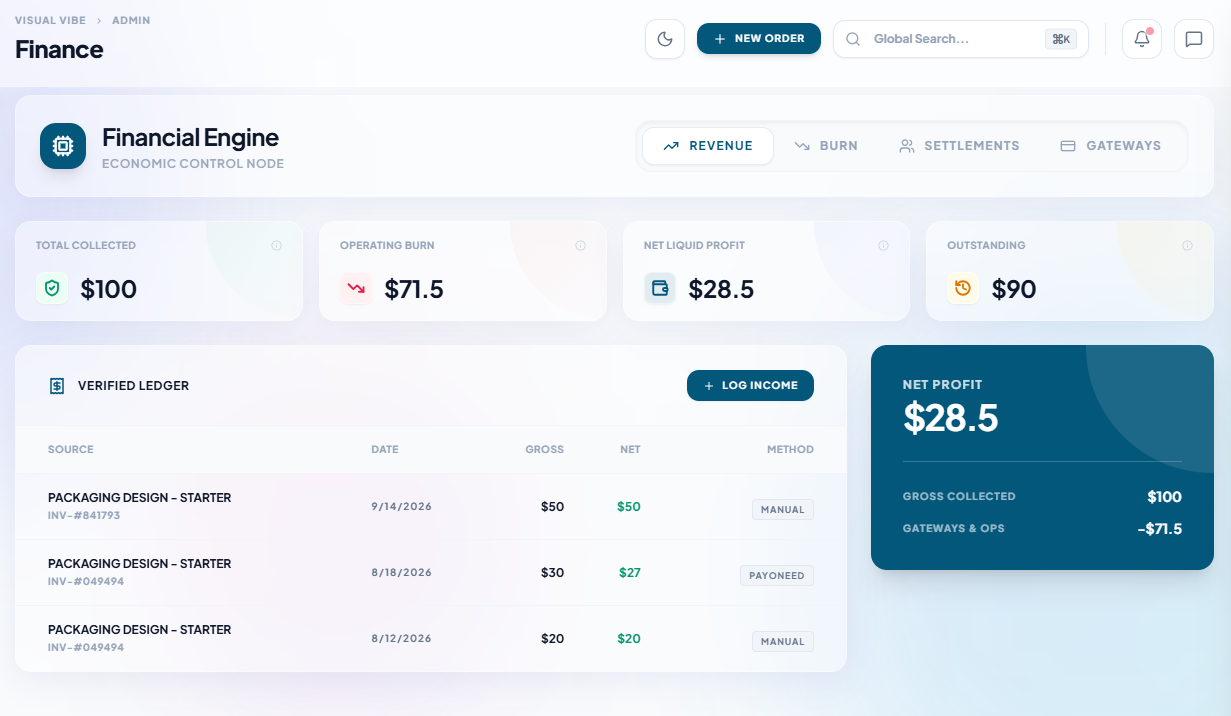
Agency profit margin shows how much revenue remains after costs. The calculation looks simple, but agencies often mix collected cash with invoiced revenue, ignore founder delivery time, omit contractor costs or compare projects in different currencies without a consistent method.
Reliable profitability begins with clear definitions. This guide separates project margin, gross margin and operating margin, then shows how to turn the numbers into practical decisions.
Core agency profit margin formula
Profit margin = (revenue − costs) ÷ revenue × 100.
If an agency earns $10,000 and total relevant costs are $7,000, profit is $3,000 and margin is 30%. The decision value depends on which revenue and costs are included.
Project margin
Project margin compares the project’s recognized revenue with direct delivery costs. Direct costs can include employee delivery time, contractor or talent payouts, project-specific software, stock assets, travel and production expenses.
Suppose a branding project has $6,000 of revenue, $2,200 of internal labor cost, $900 of external talent and $300 of project expenses. Direct cost is $3,400, gross project profit is $2,600 and project margin is 43.3%.
Assign a realistic internal cost to founder time. Treating the owner’s work as free makes founder-led projects look more profitable than they would be with a paid delivery team.
Agency gross margin
Gross margin combines revenue from all delivered services and subtracts direct delivery costs. It shows whether pricing and delivery are economically sound before general overhead.
Track gross margin by service, client and project type. An agency can have a healthy overall average while one popular service loses money through revisions or specialist costs.
Operating margin
Operating margin also subtracts overhead such as management, sales, rent, general software, insurance and administration. It answers whether the whole agency operation produces profit, not only whether client work covers delivery.
Keep overhead allocation rules consistent. Constantly changing the method makes month-to-month comparisons unreliable.
Use earned revenue and cash carefully
Invoices, recognized revenue and collected payments describe different things. An issued invoice shows what the client owes. Revenue recognition shows what the agency has earned under its accounting method. Cash collection shows what arrived.
For operational project reviews, choose a consistent rule and label it clearly. Also review outstanding balances separately, because a profitable project on paper can still create a cash problem.
Find the cause of weak margin
- Underpricing: the agreed value never covered realistic effort.
- Scope expansion: extra deliverables or revisions were absorbed.
- Poor estimation: production required more time than expected.
- Low utilization: paid capacity was not matched to suitable work.
- Expensive handoffs: missing briefs and scattered feedback caused rework.
- Slow collection: overdue payments increased financial pressure.
Use time, milestone and approval records from the agency workflow to distinguish a pricing problem from a process problem.
A four-step margin improvement plan
1. Establish a baseline
Calculate margin for recent projects using the same rules. Group results by service and client. Do not begin with a target copied from another agency; understand your current economics first.
2. Repair scope control
Define deliverables and revision limits, record approvals, and price additional work before doing it. This often improves margin without raising base rates.
3. Improve estimates
Compare estimated effort with actual delivery. Update service packages using completed project data, including project management and quality review time.
4. Change pricing or service design
Raise prices where demand supports it, narrow packages that contain too much variability, or standardize repeatable work. Stop selling services that remain weak after process improvements.
Review profitability with context
One unusually good or bad project should not decide strategy. Review trends, client concentration, collection speed, team capacity and quality outcomes. A high-margin project that damages retention or exhausts the team is not automatically a good model.
Use margin by service and client
Calculate a rolling view for each core service. If website projects average a healthy margin but ecommerce projects do not, investigate the additional discovery, integrations, testing and support. The answer may be a separate package or pricing model.
Review clients as well. A high-revenue client can be weak after senior time, meetings, payment delays and unapproved extras are included. Use the analysis to improve the relationship before deciding whether to stop serving it.
Protect margin during delivery
Set checkpoints at meaningful milestones. Compare used effort with completed value before the final stage. If 70% of planned hours are consumed while only 40% of the work is approved, the owner still has time to correct scope, assignment or expectations.
Do not wait for project closeout to discover the loss. Early signals should lead to a documented decision, not pressure on the team to hide time.
Build a monthly profitability review
- Reconcile project values, invoices and verified payments.
- Confirm employee time, talent payouts and direct expenses.
- Compare estimated and actual effort by milestone.
- Review margin by project, service and client.
- Identify overdue balances and currency exposure.
- Assign one pricing or process improvement for the next month.
Keep the formula and cost assumptions documented. When an internal rate or allocation rule changes, record the effective date so historical comparisons remain understandable.
Agencore connects project value, payments, expenses, talent payouts and time records in one finance view. See the agency analytics and finance tools or start a free trial to make profitability traceable to real project records.